 English
 Chinese
 Mongol
Redefining the construction industry with innovative solutions, cuttin-edge technology and sustainable practices
Redefining the construction industry with innovative solutions, cuttin-edge technology and sustainable practices
Profile Bending 2026-09-19
Industrial stretch bending processing is an advanced metal forming technology designed to create accurate curved components while maintaining high dimensional stability and material integrity. Unlike conventional bending methods, stretch bending combines controlled tensile force with bending pressure, allowing metal profiles to be formed into complex curves with reduced deformation and improved surface quality.
As industries continue to demand lightweight, strong, and precisely shaped components, stretch bending has become an important manufacturing solution in fields such as aerospace, automotive, architecture, transportation, and industrial equipment. With its ability to produce high-quality curved profiles efficiently, industrial stretch bending processing provides manufacturers with greater flexibility in product design and production.
What Is Industrial Stretch Bending?
Stretch bending is a metal forming process in which a workpiece is stretched under controlled tension while being wrapped around a forming die. During the process, the material experiences both tensile stress and bending force, which helps reduce common issues such as springback, wrinkles, and uneven deformation.
The process typically involves several key steps:
1. Material preparation
The selected metal profile is inspected and prepared according to project requirements. Materials may include aluminum, steel, stainless steel, and other alloys.
2. Clamping and tension application
The workpiece is securely fixed at both ends, and controlled tension is applied to maintain material stability during forming.
3. Bending around the die
The profile is gradually formed around a customized die to achieve the required radius and shape.
4. Quality inspection
The finished component is measured and inspected to ensure dimensional accuracy and surface quality meet specifications.
This controlled process makes stretch bending suitable for applications requiring consistent curvature and high precision.
Advantages of Industrial Stretch Bending Processing
1. High Precision and Dimensional Stability
One of the greatest advantages of industrial stretch bending is its ability to achieve accurate and repeatable results. The applied tensile force helps control material movement during forming, reducing unwanted distortion.
For industries where components must fit precisely into larger assemblies, such as aircraft structures or automotive frames, this level of accuracy is essential.
2. Reduced Material Deformation
Traditional bending methods may cause problems such as profile flattening, twisting, or uneven wall thickness. Stretch bending minimizes these issues by maintaining tension throughout the forming process.
This allows manufacturers to produce complex curved components while preserving the original mechanical properties of the material.
3. Excellent Surface Quality
Surface appearance is an important consideration in many applications. Because stretch bending provides better control over material flow, it can significantly reduce surface defects.
This makes the technology suitable for visible structural components used in architectural projects, transportation systems, and premium industrial products.
4. Capability for Complex Shapes
Modern product designs often require unique curved profiles that cannot be easily achieved through standard manufacturing methods.
Industrial stretch bending allows manufacturers to create large-radius curves, customized shapes, and continuous profiles while maintaining structural strength and aesthetic quality.
Applications of Industrial Stretch Bending
Aerospace Industry
The aerospace sector requires components that combine lightweight construction with high strength and precision. Stretch bending is widely used for manufacturing curved aircraft frames, structural profiles, and specialized aluminum components.
The technology helps reduce material waste while meeting strict dimensional requirements.
Automotive Manufacturing
In automotive production, curved metal components are used in vehicle frames, body structures, roof systems, and decorative elements.
Stretch bending provides manufacturers with efficient solutions for producing lightweight and aerodynamic designs while maintaining structural performance.
Architectural Applications
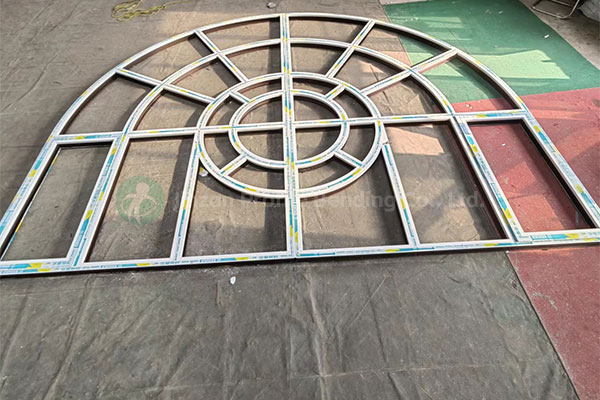
Modern architecture often incorporates curved metal structures for aesthetic and functional purposes. Aluminum and steel profiles formed through stretch bending can be used in building facades, curtain walls, entrances, and decorative structures.
The process allows architects and engineers to achieve innovative designs with reliable structural performance.
Transportation Equipment
Rail vehicles, marine equipment, and specialized transportation systems often require large curved metal profiles. Stretch bending technology helps produce these components with consistent quality and long service life.
Materials Suitable for Stretch Bending
Industrial stretch bending can be applied to various metals depending on project requirements.
Common materials include:
Aluminum alloys: Lightweight, corrosion-resistant, and widely used in aerospace and architectural applications.
Carbon steel: Provides high strength and durability for industrial structures.
Stainless steel: Offers excellent corrosion resistance and surface appearance.
Special alloys: Used for applications requiring unique mechanical properties.
Material selection depends on factors such as strength requirements, environmental conditions, design specifications, and manufacturing costs.
Factors Affecting Stretch Bending Quality
Several factors influence the final quality of stretch-bent components:
Material Properties
Different metals have different levels of flexibility, strength, and elasticity. Understanding material behavior is essential for selecting suitable forming parameters.
Tooling Design
The forming die plays an important role in achieving accurate curves. Customized tooling design helps ensure consistent results for complex profiles.
Process Parameters
Tension force, bending speed, forming radius, and equipment settings must be carefully controlled to achieve optimal performance.
Quality Control
Professional inspection methods, including dimensional measurement and surface evaluation, help ensure products meet customer requirements.
Why Choose Professional Industrial Stretch Bending Solutions?
For companies requiring precision curved metal components, professional stretch bending services provide several advantages. Experienced manufacturers can offer engineering support, customized tooling, advanced equipment, and strict quality control throughout production.
A reliable stretch bending partner can help optimize designs, reduce manufacturing challenges, and improve overall production efficiency.
By combining advanced technology with skilled manufacturing expertise, industrial stretch bending processing delivers high-quality solutions for modern metal forming challenges.
Future Development of Stretch Bending Technology
With continuous improvements in automation, digital manufacturing, and engineering simulation, stretch bending technology is becoming more efficient and precise.
Advanced CNC-controlled equipment, intelligent monitoring systems, and improved material analysis methods are helping manufacturers achieve higher productivity and better quality control.
As industries continue to pursue lightweight designs, energy efficiency, and customized structures, industrial stretch bending will remain an important technology for precision metal forming.
Industrial stretch bending processing provides advanced solutions for precision metal forming by combining controlled tension, accurate shaping, and excellent material performance. Its ability to create complex curves with minimal deformation makes it valuable across aerospace, automotive, architecture, and many other industries.
Through professional equipment, optimized process control, and customized manufacturing solutions, stretch bending technology enables companies to produce reliable, high-quality metal components that meet modern engineering requirements.