 English
 Chinese
 Mongol
Redefining the construction industry with innovative solutions, cuttin-edge technology and sustainable practices
Redefining the construction industry with innovative solutions, cuttin-edge technology and sustainable practices
Profile Bending 2026-03-02
Steel bending is a fundamental process in modern industrial manufacturing, enabling the creation of curved or angular structural components used across construction, infrastructure, machinery, and transportation industries. Whether it’s steel bars for reinforced concrete, hollow sections for frames, or custom profiles for machinery, understanding the industrial bending process and its associated cost factors is critical for manufacturers, engineers, and project managers. Jinzan Profile Bending Co., Ltd. provides a detailed overview of steel bar and profile bending processes and highlights the factors influencing the overall cost.
1. Overview of Steel Bending
Steel bending involves deforming a steel bar, tube, or profile into a desired shape without compromising its structural integrity. Unlike cutting or welding, bending maintains material continuity, reducing the risk of weak points. In industrial applications, bending is not only about achieving the right angle or curve but also ensuring repeatability, precision, and adherence to design tolerances.
Steel bending can be broadly categorized into:
Cold Bending: Performed at or near room temperature using mechanical methods such as roll bending, press brakes, or rotary draw benders. Cold bending is ideal for thinner profiles and steel bars that do not require significant curvature.
Hot Bending: Performed after heating steel to high temperatures to make it more malleable. This method is often used for thick plates or high-strength steel where cold bending might lead to cracks or deformation.
2. Common Industrial Steel Bending Processes
A. Roll Bending
Roll bending uses three or more rollers to gradually bend a steel bar or profile into curves or arcs. The steel passes through the rollers multiple times, with incremental adjustments, until the desired curvature is achieved. Roll bending is widely used for large-diameter pipes, structural channels, and heavy bars.
B. Press Brake Bending
A press brake uses a punch and die system to create angular bends in steel plates and profiles. This method allows precise control over bend angles and is suitable for medium-thickness steel sections. It is common in the fabrication of steel frames, brackets, and machinery components.
C. Rotary Draw Bending
Rotary draw bending is highly precise and commonly used for tubular steel and hollow profiles. A die rotates to guide the steel around a fixed radius, ensuring accurate curvature. This process is essential for applications where tight tolerances are required, such as automotive roll cages, pipelines, and handrails.
D. Induction or Hot Bending
For thick or high-strength steel, hot bending may be used. Steel is locally heated via induction coils or furnaces, then bent over dies or rollers. Hot bending reduces the risk of cracking and residual stress, making it suitable for structural arches, large-diameter pipelines, and heavy-duty machinery components.
3. Key Considerations in Steel Bending
Achieving quality bends requires careful planning and consideration of several factors:
Material Properties: Steel grade, yield strength, and ductility determine whether cold or hot bending is appropriate. High-strength steels often require preheating or specialized equipment.
Bend Radius: Too small a bend radius can cause cracking or kinking. The minimum bend radius is typically expressed as a multiple of the steel’s thickness or diameter.
Springback: After bending, steel tends to partially return to its original shape due to elasticity. Calculating and compensating for springback is crucial for precision applications.
Section Shape: Solid bars, hollow tubes, and complex profiles behave differently during bending. Tubular or asymmetric profiles may require specialized dies or support mechanisms to prevent distortion.
Surface Finish: Abrasions or indentations can occur during bending if dies or rollers are not properly designed. For aesthetic or high-quality applications, attention to surface protection is necessary.
4. Equipment and Automation
Modern industrial steel bending relies on a combination of manual, semi-automatic, and fully automated equipment. CNC (Computer Numerical Control) bending machines allow precise programming of bend sequences, radii, and angles. Automated roll-bending lines can handle large sections efficiently, reducing labor costs and improving repeatability. In industrial-scale production, the choice of equipment depends on steel size, complexity of bends, production volume, and required tolerance levels.
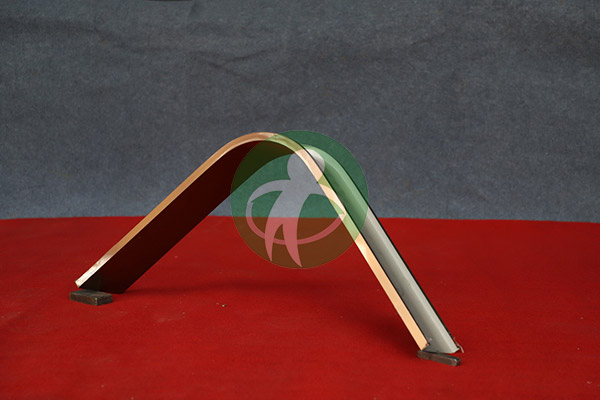
5. Cost Factors in Steel Bending
The cost of steel bending is influenced by multiple technical and operational factors:
A. Material Type and Size
Heavier, thicker, or high-strength steel requires more energy, specialized equipment, and additional handling, increasing costs. Complex profiles or reinforced bars may need multiple bends, adding to the labor and machine time.
B. Bend Complexity
Simple 90-degree bends are less costly than multi-radius curves or compound angles. Tight radii and precise tolerances often require additional passes, specialized tooling, or heat treatment, all of which contribute to higher costs.
C. Quantity and Batch Size
Larger production runs benefit from economies of scale. Setup costs are amortized over many pieces, reducing per-unit cost. Conversely, small batches may incur higher relative costs due to setup and programming time.
D. Tooling and Dies
Custom dies, rollers, and fixtures are often necessary for specific profiles or radii. Tooling costs are one-time but can be substantial, especially for complex shapes.
E. Labor and Expertise
Skilled operators are needed for programming CNC machines, supervising bending operations, and ensuring quality. Labor costs vary by region and by the level of automation.
F. Post-Bending Processes
Additional operations such as straightening, stress-relief heat treatment, or surface finishing may be required depending on application specifications. These add to total cost but are essential for structural integrity and aesthetics.
G. Logistics and Handling
Large steel profiles require cranes, forklifts, or specialized handling equipment. Transportation and storage of bent steel also impact overall project costs.
6. Quality Assurance and Standards
To ensure reliability and safety, industrial steel bending must adhere to relevant standards such as ASTM, EN, or ISO guidelines. Testing methods may include visual inspection, dimensional measurement, bend testing, and non-destructive testing for cracks or residual stress. Compliance with these standards ensures that the bent steel meets performance and safety requirements for structural, mechanical, and architectural applications.
7. Applications of Steel Bar and Profile Bending
Steel bending is used across a wide range of industries:
Construction: Curved beams, arches, reinforcement bars, and custom structural supports.
Infrastructure: Bridge girders, handrails, pipelines, and tunnels.
Automotive and Transportation: Roll cages, chassis components, exhaust pipes, and safety frames.
Industrial Machinery: Frames, conveyor components, and custom machinery parts.
Architectural Projects: Decorative steel elements, curved façades, and roof structures.
8. Optimizing Costs and Efficiency
Manufacturers can optimize costs and efficiency by:
Using CNC bending equipment for high-volume production.
Consolidating bends to reduce handling and setup time.
Choosing standard profiles where possible to minimize custom tooling.
Implementing quality checks during intermediate stages to reduce rework.
Planning bending sequences to minimize material stress and springback compensation.
Industrial steel bar and profile bending is a complex process requiring careful consideration of material properties, bending methods, equipment, and post-processing requirements. Costs are influenced by material type, bend complexity, batch size, tooling, labor, and quality requirements. By understanding these factors and leveraging modern CNC or automated bending technologies, manufacturers can achieve precise, repeatable results while controlling costs. In applications ranging from construction to automotive and machinery, steel bending remains a critical manufacturing process, combining structural integrity, efficiency, and design flexibility.